

Budget- Friendly Beans
Bulk beans from the co-op are one of the most economical sources of protein, fiber, and essential vitamins.
Dried beans from the bulk bins are a smart choice – a way to save money, hone your kitchen skills, and maintain control of what goes into your food. Bonus: buy as much or as little as you want, and remember, beans will double in volume when cooked. The little extra time and effort that dried beans require is worthwhile. We even have some local varieties available. However, if you don’t have the time, you can still enjoy the benefits. The co-op carries bean in many forms – dried in bags, cooked in cans and jars, seasoned and plain. They are also available in vacuum packed pouches, pre-seasoned, and in ready made products like salsas and hummus. No matter how you buy them, beans are a budget-friendly, plant-based powerhouse for any meal.
How to cook beans
Most beans may be cooked as follows:
Rinse beans in colander and pick out any stones or shriveled beans that might be mixed in.
Soak beans (except, lentils or split peas) overnight or for eight hours at room temperature. Use six cups of cold water per one pound of beans.
Drain soaked beans. Add fresh water (see chart below for quantities) to a large pot and bring beans to a boil. Cover the pot, with the lid tilted slightly so the steam can escape. Gently simmer the beans for the time indicated below.
Tips for making beans more easily digestible
Add a strip of Kombu (sea vegetable) to pot.
Discard soaking water, and use fresh water for cooking
Add Beano® enzyme drops to cooked beans.
Add a little vinegar toward the end of cooking.
Only salt beans at the end of cooking.
Quick soak method
Bring beans and water to a boil, boil for two minutes, cover and remove from heat. Allow to stand one hour, drain water and proceed with cooking instructions.
Pressure cooker method
Follow manufacturer’s instructions for your cooker. Do not pressure cook small beans. They clog release valves and quickly overcook. Use two cups water per cup of dried beans.
cooking times & yields | nutritional information | ||||||||
|---|---|---|---|---|---|---|---|---|---|
| Name of legume (one cup dry) | Water needed (cups) | Stovetop time (minutes) | Pressure cooking (minutes) | Approx. yield (cups) | Calories | Carbs | Fat | Fiber | Protein |
| Black | 3 | 45-60 | 20-25 | 2 | 113 | 20.5 | 0.5 | 7.5 | 7.5 |
| Garbanzo | 4 | 90-120 | 20-30 | 21/2 | 134 | 22.5 | 2 | 6 | 7.5 |
| Great Northern (Navy) | 4 | 60-90 | 25-30 | 21/4 | 104 | 18.5 | 0.5 | 6 | 7.5 |
| Kidney/Cannellini | 21/4 | 90-120 | 20-25 | 2 | 104 | 18.5 | 0.5 | 5.5 | 7.5 |
| Lentils, brown | 3 | 45-60 | never | 2 | 115 | 20 | 0.5 | 8 | 9 |
| Lentils, red | 3 | 20-30 | never | 2 | 135 | 23.5 | 0.6 | 5.8 | 8 |
| Mung | 21/2 | 45-60 | never | 2 | 106 | 19 | 0.5 | 7.5 | 7 |
| Pinto | 3 | 60-90 | 20-25 | 21/4 | 126 | 23.5 | 0.5 | 4.5 | 7.5 |
| Split Peas | 3 | 45-60 | never | 2 | 115 | 20.5 | 0.3 | 8 | 8 |
| One cup of beans weighs half a pound, and yields 2-3 cups of cooked beans. | Information for one half-cup of cooked beans. Carbohydrates, fat, fiber, and protein measured in grams. | ||||||||
Try one of these great recipes!
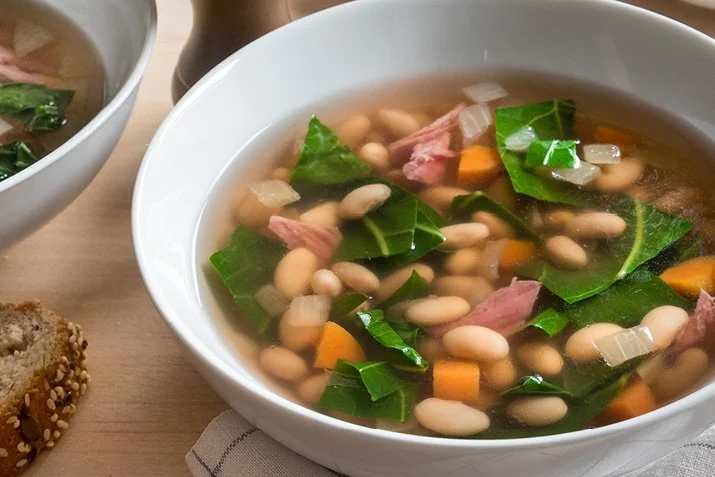
White beans are creamy and mild tasting, and they take on the smoky flavor of a ham hock or turkey leg.

This soup adds loads of vegetables to the familiar flavors of red beans and rice.
Common types of beans and ways to enjoy them
Black beans
Black beans (also called turtle beans) are especially popular in Mexican, South American and Cuban cuisines. These dark and tasty beans stand up to bold seasonings like chilies and savory herbs. They are a nice change of pace from pinto beans in Southwestern specialties like tostadas and tacos.
Split peas
Split peas are small round peas that naturally split in two when dried. They become a soft pulp when cooked and are used primarily for soups and stews. Both yellow and green split peas have an affinity with tomatoes, potatoes and rice. Split peas are delicious in dal, a spicy side dish commonly served in India.
Garbanzo beans
Garbanzo beans, (or chickpeas) are versatile and unique with a mild nutty flavor. The main ingredient in popular Middle Eastern dishes like falafel and hummus, these beans also taste great in salads with fresh hewrbs and lots of onion and garlic.
Great Northern beans
Great Northern beans (or navy beans) are classic soup beans, white with a mild flavor and creamy texture. They puree nicely and can be used to thicken soups and milk-based chowders, or served on their own as an elegant side dish.
Lentils
Lentils are best known for making hearty soups. There are many types of lentils, but common varieties are small flat red lentils, larger brown lentils, small brown French lentils and smooth green lentils. All lentils are fast cooking and do not require presoaking. Lentils are popular in Indian, Mediterranean and Middle Eastern cuisine.
Pinto beans
Pinto beans, the traditional bean of the southwest United States and Mexico, are speckled pink and brown when dry, fading to brown when cooked. They have a full-bodied, earthy flavor and are good in casseroles, rolled into a tortilla, or refried. They are served in any number of spicy Southwestern dishes.
Kidney beans
Kidney beans and the slightly smaller red beans are some of the most popular in the United States. Kidney beans are often used in chili, soups and marinated bean salads. Firm, flavorful red beans are a key ingredient in Creole classic red beans and rice.
Mung beans
Mung beans are very popular in Asian and Indian cuisine. They have a firm, dense texture and their flavor is complemented by curries, chilies and ginger. Mung beans can be substituted for lentils or adzuki beans in many recipes. Precooked mung beans and sprouted mung beans are delicious additions to a vegetable stir-fry.